
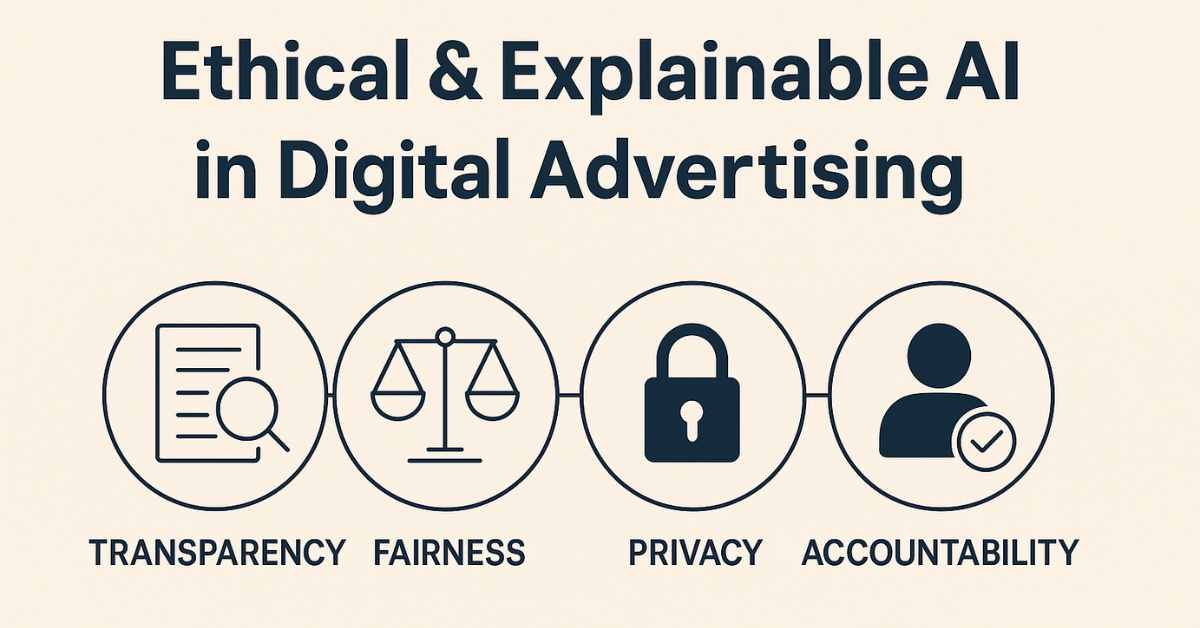
AI has become a powerhouse behind modern ad campaigns, enabling hyper-targeting, creative optimization, and performance scaling. But with that power comes responsibility. If brands use AI without transparency or guardrails, they risk eroding user trust, violating privacy, or perpetuating bias.
In this article, we explore ethical AI in digital advertising — its principles, why explainable AI matters, risks & challenges, and strategies for implementation. This is your blueprint to keep AI in your advertising stack not only effective, but trustworthy and fair.
Quick Facts at a Glance
| Concept | Why It Matters | Key Benefit |
|---|---|---|
| Explainable AI (XAI) | Prevents “black box” models in ad decisions | Helps marketers and audiences understand how decisions are made |
| Bias & Discrimination | AI can unintentionally discriminate (gender, race, income) | Ethical safeguards reduce legal & reputational risk |
| Regulatory Pressure | Laws require transparency, consent, fairness | Brands that comply early gain competitive edge |
| Human + AI Collaboration | AI assists, humans audit | Better accountability and trust in decision loops |
Core Principles of Ethical AI in Digital Advertising
To ground your AI strategy ethically, you need principles that guide design, deployment, and monitoring.
Transparency & Explainability
Transparency means showing what the AI does (e.g. uses demographic signals, looks at behavior, scoring) and why it does it (how much weight each factor has). Explainable AI makes that possible by turning “black box” models into interpretable ones.
Without explainability, marketers and end users are left in the dark. As one expert puts it: “Explainable AI tools provide insight into how and why they reached a particular decision.”
Fairness, Bias Mitigation & Non-Discrimination
AI models are only as fair as their data. Bias in training data or target selection (e.g. excluding low-income groups, minorities, or underrepresented communities) can lead to discriminatory ad delivery.
Explainable AI helps by exposing which features drive decisions, so you can detect and correct bias.
Ethical AI practice demands you constantly audit models for disparate impact, run fairness tests, and set thresholds to avoid harmful targeting.
Privacy & Consent
Ethical AI must respect users’ privacy and work with explicit, informed consent. Users should know what data is used in ad targeting and why. This aligns with data protection laws like GDPR and similar rules globally.
You should anonymize or aggregate sensitive signals and avoid using deeply personal or sensitive features (health, religious beliefs, etc.). Transparency to users about data use builds trust.
Accountability & Governance
Who is responsible if the AI misfires? You need defined governance — teams or roles that oversee model decisions, audits, error reporting, appeals, and correction.
Governance includes documentation (model cards, decision logs), regular reviews, and escalation paths if issues arise. Transparent algorithms help in holding stakeholders accountable.
Why Explainable AI Is Crucial in Advertising
Explainable AI (XAI) is especially relevant for advertising because ads influence decisions, budgets, and public perception. Here’s why XAI matters in this space:
Demystifying the Black Box
Many ad platforms treat algorithms as opaque—“we decide best audiences” without revealing logic. This leaves marketers guessing why some campaigns succeed or fail. The research paper Against Opacity calls this out as a barrier to trust and optimization.
By embedding explainability, marketers can see which features the algorithm prioritized (e.g. age, interest, past behavior) and adjust or contest it.
Better Optimization & Strategic Feedback Loops
With XAI, you don’t blindly trust whatever the system recommends. You ask: Why did it prefer audience A over B? You can see feature importances, anomalies, and intervene. This feedback loop drives smarter optimization.
Compliance with Emerging Regulations & Ethics Norms
Regulators increasingly demand explainability in automated decisions, particularly in consumer-facing systems. Brands that already have XAI pipelines are less exposed to compliance risk
Ethical norms in the marketing community also favor transparent practices — brands that hide algorithmic logic risk scrutiny or backlash.
Restoring Trust & Brand Reputation
Consumers are wary of opaque algorithms manipulating outcomes. When brands show how decisions are made — or allow recourse — trust rises. Transparent AI becomes a differentiator.
Challenges & Risks in Ethical AI Advertising
Even with strong principles, applying ethical AI is hard. Here are common challenges:
Complexity vs. Explainability Trade-Off
More accurate models (e.g. deep neural nets) tend to be more opaque. For explainability, you may need simpler models or post hoc explainers (SHAP, LIME) — but those may lose nuance.
Proxy explanations may mislead — evaluating XAI quality is nontrivial
Hidden Data Bias & Feature Leakage
Even with explainability, some biases are subtle (e.g. correlated features, proxies). Models may pick proxies (zipcode as income proxy) and hide discrimination behind plausible correlations.
Operational & Cost Overhead
Embedding explainability, audits, governance, oversight teams — all add cost and complexity. Smaller agencies may struggle to adopt full ethical AI pipelines.
Platform Black Boxes & Limited Access
Many ad platforms (Facebook, Google Ads) do not expose full model internals to advertisers. You often see bits of attribution, but not full logic. That limits your ability to audit.
Regulatory Uncertainty & Evolving Standards
Laws and norms are still evolving. What’s considered “explainable” today may not suffice tomorrow. Ethical AI must adapt.
Strategies & Best Practices for Implementing Ethical & Explainable AI in Ads
Here’s your actionable plan to build more ethical AI into your advertising stack:
Use Interpretable Models Where Possible
Start with models that naturally support interpretability (e.g. decision trees, gradient boosting) or simpler logistic regression for critical decisions. Use complex models only when they add clear value.
Apply Post-hoc Explainability Tools
Use tools like SHAP, LIME, ELI5 to explain black-box outputs in human-readable terms. These help you see feature importance or class contributions.
Document and validate these explanations regularly.
Audit for Bias & Fairness Regularly
Run fairness checks: demographic parity, equalized odds, disparity analysis across segments. Use explainability to detect features that disproportionately affect certain groups.
Adjust thresholds, constraints, or exclude sensitive features when necessary.
Maintain Decision Logs & Model Cards
Keep logs of inputs, outputs, and explanatory features for each decision. Create model cards (public or internal) documenting:
-
Purpose of model
-
Intended use cases
-
Known limitations & biases
-
Feature importances
-
Performance metrics across groups
This helps accountability and audits.
Human-in-the-Loop Controls
Never fully automate decisions that impact users without oversight. Build approval or review gates when model decisions deviate from norms or cross thresholds.
Transparent Disclosures & User Controls
Communicate to users (via privacy policy or prompts) that AI assists ad targeting, what kinds of signals are used, and how they can opt out or adjust preferences.
Collaboration with Platforms
Work with ad platforms to request more explainability APIs or get access to attribution breakdowns. Push for standard transparency tools across the ecosystem.
Continuous Monitoring & Updates
Ethical AI is not “set and forget.” Monitor performance drift, bias drift, model decay, and update your explainability pipelines accordingly.
Real-World Use Cases & Research Examples
-
The Against Opacity paper argues for merging explainable AI with large language models to aid advertisers in interpreting opaque platform decisions
-
The SOMONITOR framework blends LLMs + explainability for marketing analytics, letting human marketers parse AI decisions.
-
Marketers using XAI report better trust in automations and clearer paths to tweak campaigns based on model explanations.
-
Ethical considerations are increasingly flagged in AI marketing trend reports, emphasizing transparency, fairness, and building trust.
Conclusion & Future Outlook
Ethical AI in digital advertising is no longer optional — it’s essential. Brands that ignore transparency, explainability, and fairness risk backlash, regulatory penalties, and degraded trust.
But the landscape is promising: new explainable AI tools, open research, better governance frameworks, and platform pressure are all pushing toward more ethical ad ecosystems. We’re likely to see:
-
Standardization of explainability APIs by ad platforms
-
Regulatory mandates for algorithmic transparency in advertising
-
Greater client demand for auditability and ethical claims
-
Tooling innovations that make XAI easier and cheaper
If you build or run ad campaigns, begin embedding explainability and ethics now. The first to do so will gain not just compliance peace of mind, but competitive trust in a data-driven future.
FAQs
Q: Is explainable AI always possible in complex ad models?
A: Not always fully. Complex models like deep neural nets are harder to interpret. But you can use post-hoc tools (SHAP, LIME) or hybrid models to approximate explanations.
Q: What features should be excluded to stay ethical?
A: Avoid using sensitive attributes (race, religion, sexual orientation, health) or proxies that strongly correlate with them. Use fairness filters and audits.
Q: Do platforms like Meta/Google support explainability already?
A: Partially. They give some attribution or breakdowns, but rarely full model logic. Advertisers have limited visibility and must push for more access.
Q: What’s the return on investing in ethical AI?
A: Beyond compliance, you build trust with users, reduce reputation risk, attract client interest in “responsible AI,” and get better insight into your marketing decisions.
-
Explore our case studies on ad campaigns & analytics