
Learn how to harness micro-moments and craft intent-driven content to engage users at the right time, boost conversions, and stay ahead in 2025’s fast-paced digital world.
Introduction
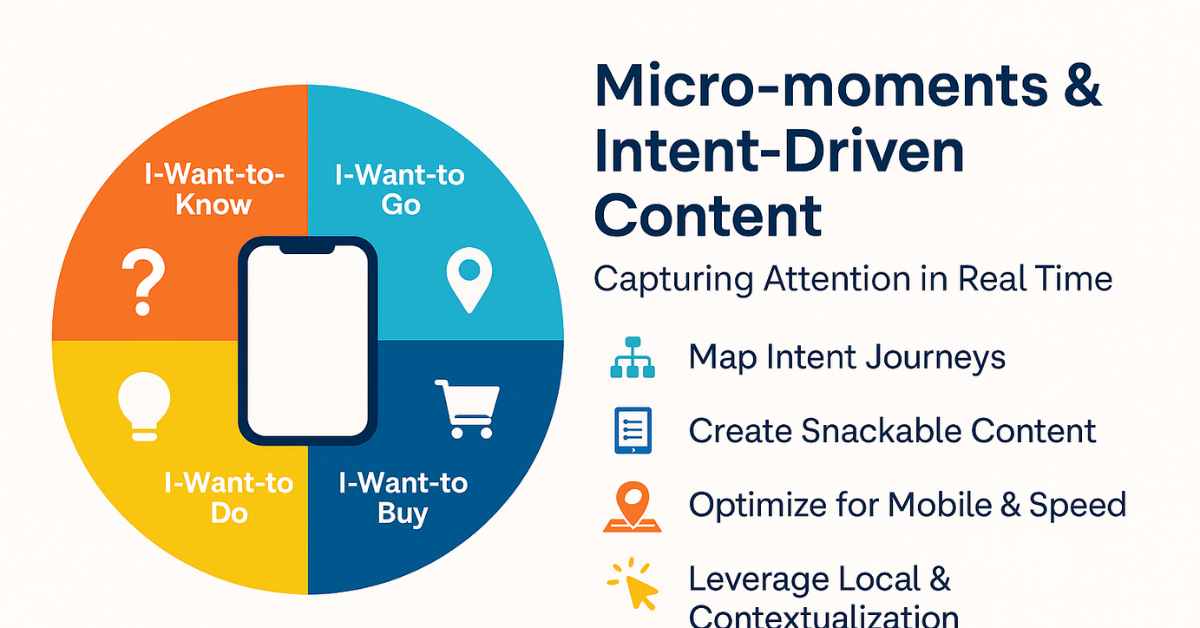
In today’s mobile-first world, decisions are more instantaneous than ever. Users don’t wait — they act in micro-moments: fleeting, intent-rich instances when someone reflexively turns to their device to know, go, do, or buy.
To win in these moments, your content must be ready — concise, relevant, and frictionless. In this blog, we’ll deep dive into what micro-moments are, why they matter more than ever in 2025, and a step-by-step playbook to align your strategy with user intent so you capture attention when it matters.
What Are Micro-Moments?
Google first defined the concept in 2015 as brief, intent-driven moments when people turn to devices for answers (e.g. “I want to know,” “I want to go,” “I want to do,” “I want to buy”).
These are not “sessions” or long browsing periods, but immediacy windows — often seconds — where users expect your brand to provide the right response.
Types of micro-moments:
| Micro-Moment Type | Description | Example |
|---|---|---|
| I-Want-to-Know | Users are seeking information or insights | “How to tie a tie” |
| I-Want-to-Go | Users looking for local places or directions | “Coffee shop near me” |
| I-Want-to-Do | Users seeking help, instructions or how-tos | “How to fix my phone screen” |
| I-Want-to-Buy | Users ready to purchase and deciding | “Buy wireless earbuds online” |
These moments are intent-loaded — users aren’t browsing aimlessly. They have a task, a need, or a decision point.
Why Micro-Moments & Intent Matter More in 2025
1. Rising mobile & instant-expectation culture
India is already a predominantly mobile-first market, and user patience is shrinking. LinkedIn+1 People expect answers nearly instantly.
2. Short attention spans & content fragmentation
With more content vying for attention, you must win users in under a glance or swipe.
3. AI & SERP changes emphasize snippets & answers
Search engines now surface answers directly (zero-click). If your content isn’t optimized for quick consumption, you lose. DigeeSell+1
4. Micro-moments are core to brand relevance
Brands that meet users at key micro-moments convert more, build trust, and stay top-of-mind. A recent piece notes micro-moments as a top trend for branded content in 2025. HT Media
5. Real-world examples from India
-
Zomato used real-time cricket commentary to tie in snack references during IPL — quick, contextual, and engaging. RedCrabs
-
Nykaa timed Diwali tutorials and swipe-up purchase links in Stories, matching intent when users were exploring looks. RedCrabs
These show how brands are not waiting — they lean into micro-moments.
How to Capture Micro-Moments: Step-by-Step Playbook
Here’s a tactical framework you can adopt:
1. Map Intent Journeys & Identify Micro-Moment Triggers
-
Use analytics, search console, and heatmaps to find where and when users drop off.
-
Find “trigger queries” — e.g. “near me,” “how to,” “best xyz.”
-
Map which micro-moment types your users go through.
2. Create Intent-Aligned, Snackable Content
-
Use ultra short headlines, bullet points, tables, FAQs.
-
Always lead with the answer — not bury it.
-
Structure for SERP features (FAQ schema, Featured Snippets).
3. Optimize for Mobile & Speed
-
Ensure pages load < 3 seconds.
-
Use responsive layouts, lazy loading, compressed images.
-
Avoid intrusive popups or heavy scripts.
4. Leverage Local & Contextualization
-
For “go” moments, use local keywords, maps, store locators, hours.
-
Use geotargeted content/ad copy.
5. Trigger Action Quickly
-
Use buttons like “Call Now,” “Order,” “Book,” “Check Price.”
-
Use deep linking where possible (e.g. into app).
-
Pre-fill forms, reduce friction.
6. Use Dynamic & Personalized Content
-
Use session-based dynamic blocks (e.g. “You were last viewing…”).
-
Use behavioral triggers (e.g. change CTA based on scroll or time on page).
7. Align Paid & Organic for Micro-Moments
-
Combine Search + Social + Display ads targeting micro-moment keywords.
-
Use dynamic keyword insertion, context targeting.
8. Test, Learn & Optimize Fast
-
A/B test headlines, CTAs, layouts.
-
Monitor metrics like bounce rate in micro-moment pages, scroll depth, CTR.
-
Adjust based on what delivers answers fastest.
9. Scale via Content Clusters
-
Group micro-moment pages under pillar topics.
-
Internal link between micro pages (like “how-to,” “top list,” “local option”).
Challenges & How to Overcome Them
| Challenge | Solution / Best Practice |
|---|---|
| Too many moments, limited resources | Start with top-value micro-moments (e.g. “Buy,” “Know”) then expand |
| Measuring impact is tricky | Use micro-conversion metrics (tap, scroll, CTA click) |
| Content fatigue or redundancy | Rotate templates, refresh periodically |
| Organizational silos | Align SEO, content, paid teams to micro-moment ops |
Metrics & KPIs to Watch
-
CTR / Impressions on “micro-moment” pages
-
Time to first action (how quickly users engage)
-
Bounce / pogo-stick rate
-
Conversion rate (from micro-moment interactions)
-
Scroll depth / engagement
-
Featured snippet ownership, FAQ click-through
Indian Market Nuances & Localization
-
Use regional language queries (Telugu, Hindi, Tamil)
-
Capture vernacular “how to / where to buy near me” searches
-
Use local festivals, events, cultural moments
-
Leverage WhatsApp and voice-based queries
In 2025, Indian brands pushing micro-moments are those mastering not just speed, but relevance and cultural context.
Micro-moments are where real-time intent becomes conversion. If your users expect answers in an instant, your brand better show up — fast, precise, and helpful.
Start by mapping your users’ micro-moment triggers, build lightweight content that aligns to those intents, remove friction, and track user micro-behaviors. In 2025, brands that win micro-moments capture not just clicks, but loyalty.
FAQs
Q1: Should I optimize every page for micro-moments?
Not necessarily. Focus first on high-intent pages (how-to, local, product pages). Expand gradually.
Q2: How long should micro-moment content be?
As short as needed — 150 to 400 words is okay if it solves the intent immediately.
Q3: Can micro-moments work in B2B?
Yes — e.g. “How to calculate ROI,” “best CRM tools 2025” are micro-intent queries in B2B.
Q4: How often should I refresh micro-moment pages?
Every 3–6 months, or when trends / search behavior shifts.