
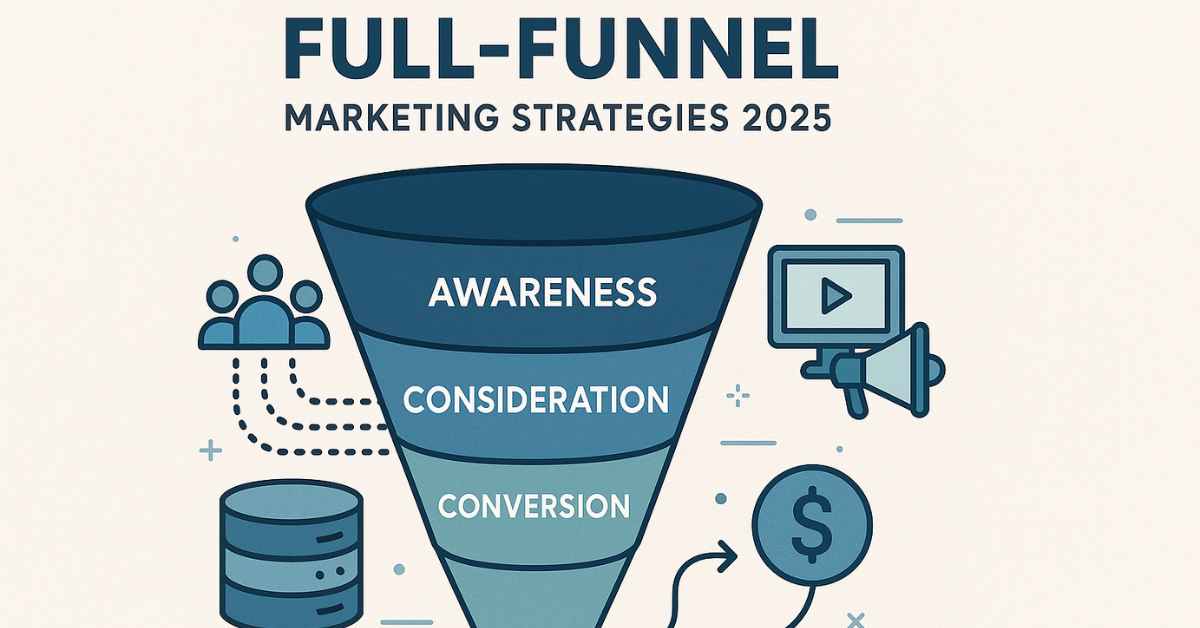
In 2025, the marketing landscape has shifted dramatically. With third-party cookies largely under threat, consumer privacy regulations tightening, and customer journeys becoming increasingly non-linear, the way brands build relationships and drive growth needs an overhaul. That overhaul centres around two critical components: first-party data and full-funnel marketing strategies. For digital agencies like Epixs and brands they serve, mastering this duo is no longer optional — it’s a strategic imperative. In this blog we’ll unpack why first-party data and full-funnel marketing are vital this year, how they integrate, and concrete steps you can take to implement them successfully.
Quick Facts
-
First-party data is collected directly via owned channels (websites, apps, CRM), making it more accurate, privacy-compliant and future-proof than third-party data.
-
The funnel is no longer linear; modern buyer journeys are multi-touch, cross-device and require coordinated full-funnel strategies that span awareness to retention.
-
Brands that integrate first-party data with full-funnel approaches can deliver more personalised, measurable, and high-ROI campaigns.
What is First-Party Data and Why It Matters in 2025
The shift to first-party data is more than a buzzword — it’s a necessary evolution.
Defining First-Party Data
First-party data refers to information your organisation collects directly from users via your own channels: website interactions, app usage, CRM records, email engagement, in-store loyalty programmes, etc.
Unlike second- or third-party data, this is owned, accurate and collected with the user-brand relationship at its core.
Why It’s Critical in 2025
-
Privacy & regulation: With strict laws like General Data Protection Regulation (GDPR), California Consumer Privacy Act (CCPA) and the phasing out of third-party cookies, brands must rely on compliant data sources.
-
Data accuracy & relevance: First-party data is drawn from real users engaging with your brand — higher quality insights, less noise.
-
Control & competitive advantage: Because you own the data, you aren’t depending on external vendors or platforms. That gives your marketing agility and resilience.
-
Activatable across funnel stages: You can use first-party data not just for acquisition but for nurturing, conversion, retention and loyalty. This makes it ideal for full-funnel strategies.
Understanding Full-Funnel Marketing Strategies
“Full-funnel marketing” means managing and optimising the customer journey from initial awareness all the way through to loyalty and advocacy, not just focusing on the bottom of the funnel.
The Evolved Funnel in 2025
According to recent analyses, the funnel has become a “maze” rather than a straight line. Modern customers hop between channels, devices and touch-points — brands must coordinate across awareness, consideration, conversion and post-purchase retention.
For example:
-
Top-of-funnel: brand awareness, thought-leadership, social engagement
-
Middle-of-funnel: nurturing, retargeting, personalised messaging
-
Bottom-of-funnel: conversion optimisation, checkout simplicity, incentives
-
Post-purchase & retention: upsells, loyalty programmes, community building
Why Agencies and Brands Must Adopt It
-
Single-channel, siloed campaigns no longer suffice in a fragmented landscape. Agencies delivering full-funnel strategies are in high demand.
-
Full-funnel enables measurement across the journey, not just last-click conversion, thereby showing true ROI.
-
It allows brands to build deeper relationships — not just transacting once but retaining customers, increasing lifetime value.
Why the Marriage of First-Party Data + Full-Funnel Strategies is a Game-Changer
When you combine first-party data with full-funnel marketing, you unlock high impact:
Precision Targeting at Every Stage
With rich first-party data you can segment audiences by behaviour (site visits, content consumed, product interest), then deliver the right message at the right funnel stage.
For example: someone who visited your pricing page (first-party behaviour) enters a tailored retargeting stream via your full-funnel approach.
Privacy-Compliant Personalisation
Because first-party data is collected via consent and your own channels, you can personalise across the funnel while staying compliant. This builds trust and future-proofs your marketing.
Measurement & Attribution Across the Journey
When you own your data and control funnel stages, you can better attribute marketing efforts, forecast outcomes (AI/ML tools now help) and allocate budgets more intelligently.
Competitive Edge & Customer Loyalty
Brands that invest in their own customer data and orchestrate full-funnel experiences win in retention, upsell and brand advocacy. First-party data enables insights into who your best customers are and why — enabling marketing focused on long-term value, not just acquisition.
How to Implement First-Party Data & Full-Funnel Marketing — A Practical Guide for Agencies
As a digital solutions agency (like Epixs), here’s a step-by-step workflow you can apply for your clients:
Step 1: Audit & Data Foundation
-
Evaluate current data assets: website analytics, CRM, email lists, offline interactions.
-
Ensure compliance: consent mechanisms, data governance, privacy policy alignment.
-
Set up or refine your Customer Data Platform (CDP) or marketing data infrastructure to unify first-party data.
Step 2: Map the Customer Journey & Funnel Stages
-
Define key funnel stages: Awareness → Consideration → Conversion → Retention.
-
Map current performance and gaps at each stage. Use first-party data to identify behaviour patterns (e.g., which pages visited before conversion).
-
Establish metrics/KPIs for each stage (e.g., email open for middle-funnel; repeat purchase for retention).
Step 3: Build Data-Driven Segments & Content Streams
-
Use first-party data to segment audiences: e.g., high-engagement visitors, abandoned-cart users, loyal repeat buyers.
-
For each segment and funnel stage, create tailored content and offers: thought-leadership for awareness, nurturing content for consideration, targeted incentives for conversion, loyalty perks post-purchase.
-
Use realtime triggers: someone downloads a whitepaper → enters nurture sequence; someone buys → receives loyalty offer.
Step 4: Activate Across Channels & Orchestrate
-
Deploy campaigns across owned (email, website), paid (ads), earned (social) media using unified first-party signals.
-
Retarget behaviours based on first-party data: e.g., users who viewed product category X but didn’t purchase.
-
Ensure messaging consistency and funnel stage alignment across channels.
Step 5: Test, Measure & Optimise Continuously
-
Use first-party data for attribution modelling: which segments, messages, channels deliver best outcomes?
-
Monitor funnel drop-offs: where are users getting stuck? Use data to iterate.
-
Leverage AI/ML tools for forecasting and budget optimisation (as noted in recent industry reviews).
-
Integrate retention metrics: repeat purchase rate, customer lifetime value (CLV).
Step 6: Maintain Hygiene & Governance
-
Keep data clean and current: prune outdated contacts, ensure consent refresh.
-
Document data flows, ensure auditability and transparency for clients.
-
As privacy regs evolve, stay up to date — first-party data strategy must adapt.
The marketing horizon for 2025 demands agility, purpose and data-centric thinking. The convergence of first-party data and full-funnel marketing strategies offers a blueprint for brands and agencies: one that is resilient in the face of privacy shifts, aligned with modern customer behaviour, and capable of driving meaningful business outcomes. By owning your data, managing the full customer journey and orchestrating personalised, cross-channel experiences, you position your clients — and your agency — for growth in the years ahead. Embrace this strategic shift early, and you’ll build marketing that’s not only effective today, but future-ready for whatever comes next.
FAQs
Q: Are full-funnel strategies only for large brands with big budgets?
A: No. While large brands may have more channels and scale, full-funnel thinking applies to businesses of all sizes. The key is defining your funnel, mapping data-driven behaviours, and executing with discipline — even a smaller budget can deliver meaningful results when you leverage first-party data smartly.
Q: How quickly can we expect to see ROI from first-party data and full-funnel marketing?
A: It depends on your starting point. If your data infrastructure and consent mechanisms are ready, you may start seeing improvements in targeting and conversion within months. However, full optimisation across the funnel (including retention) may take 6-12 months. Patience + continuous iteration pay off.
Q: What if my website/tracking is not capturing enough first-party data yet?
A: Begin with foundational steps: improve website tracking (analytics, events), ensure CRM captures meaningful behaviours, create opt-in opportunities (subscriptions, downloads). You can build gradually — the important part is to start collecting accurate, consented data now rather than waiting.
Useful Links
Author Pack
Author: Priya Sharma — Senior Web & Digital Strategist at Epixs Media Blog.
Bio: Priya specialises in modern UI/UX design, WordPress site builds and digital marketing strategies. She writes to bridge the gap between design trends and practical implementation.
Profile Image Alt Text: Priya Sharma Epixs Media Blog author
Publish Date: 2025-10-22
Last Updated: 2025-10-22
Fact-checked by: Epixs Media Review Team