
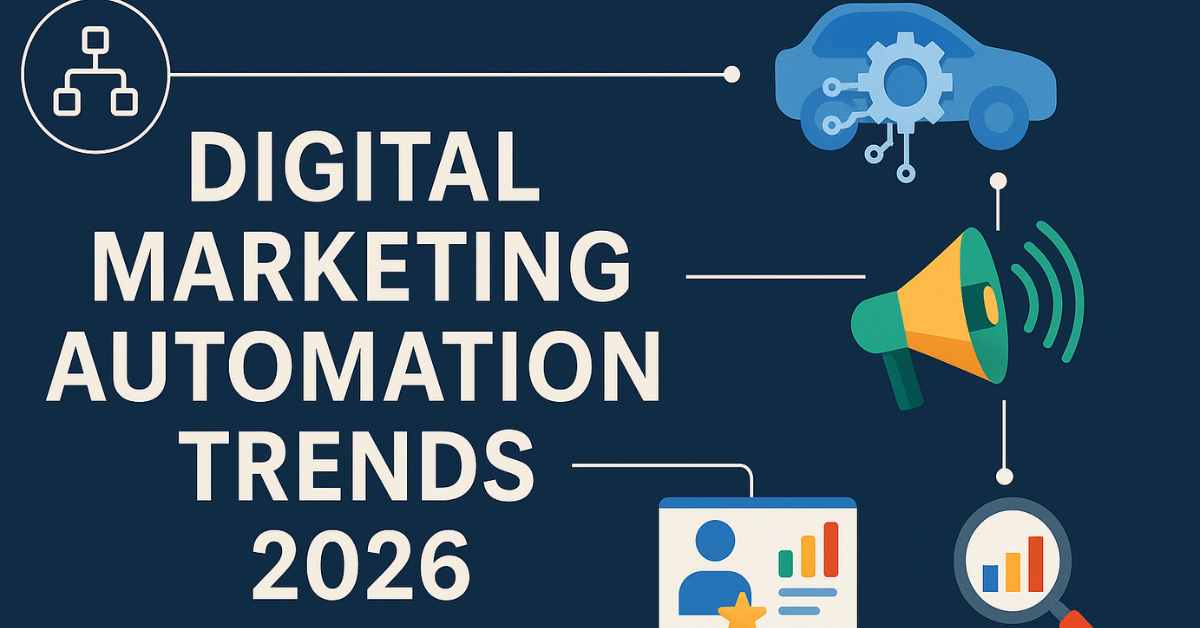
Explore key digital marketing automation trends for 2026—AI-driven workflows, omnichannel orchestration, hyper-personalisation, and analytics for Indian agencies and businesses.
In 2026, the digital marketing landscape is shifting from simple automation to truly intelligent orchestration. For agencies and businesses in India and beyond, embracing the Digital Marketing Automation Trends 2026 is no longer optional—it’s central to delivering competitive, scalable, and high-impact campaigns. From AI-powered content generation and predictive analytics, to omnichannel flows and hyper-personalised experiences, automation is evolving fast. In this article we’ll unpack the most important trends, show why they matter (especially in the Indian context), and how you can implement them in your agency or business.
Quick Facts
-
India’s digital marketing ecosystem is projected to grow rapidly, with key drivers being AI-driven marketing automation, video dominance, influencer collaborations and automation workflows.
-
Marketing automation platforms are now incorporating AI, chatbots, voice search optimisation and omnichannel journey orchestration.
-
For Indian businesses, omnichannel marketing (across websites, social, messaging apps) and lifetime-value based automation are becoming critical.
Key Automation Trends for 2026
AI-Driven Predictive & Adaptive Automation
One of the strongest trends for 2026 is that automation isn’t just about triggering email flows or scheduling social posts—it’s about using AI to predict behaviours, adapt journeys, and optimise content in real time. Tools will analyse signals (user behaviour, channel interactions, device, location) and adjust workflows accordingly.
How to apply:
-
Implement predictive scoring for leads and automate next-best-action flows (e.g., send a tailored offer instead of generic nurture)
-
Use generative AI for content variants, scheduling at optimal times, and automating creative testing
-
Monitor outcomes, feed results back into machine-learning loops, continuously optimise
Omnichannel Orchestration & Unified Journeys
Consumers today interact via multiple channels: social, messaging apps, email, website, offline. In 2026, automation must orchestrate across all touchpoints, ensuring seamless journeys regardless of channel. For Indian businesses, where WhatsApp, Instagram, and mobile apps dominate, this is especially relevant.
Implementation suggestions:
-
Map customer journey across all channels and identify where automation can trigger cross-channel flows (e.g., user abandons chat, send push + WhatsApp message)
-
Use a unified marketing automation platform or integrate CRM + messaging + social so data flows freely
-
Ensure consistent messaging, branding and data-driven triggers across channels
Hyper-Personalisation & Dynamic Content Automation
Generic campaigns are losing effect. Automation in 2026 needs to deliver personalised experiences at scale—content, offers, timing, channel all tailored to the individual. The combination of data + AI + automation enables this.
Steps for agencies/businesses:
-
Segment audiences dynamically (behavioural + contextual + predictive)
-
Use dynamic templates in email/social/ad content so that elements (image, headline, offer) change per viewer
-
Automate testing of personalisation variables and roll out winners
Automation for Efficiency + Performance, Not Just Activity
In 2026, marketing automation will be judged by results: improved ROI, reduced waste, faster cycle times—not simply more workflows. Efficiency, performance, and smart measurement become key.
Actionable ideas:
-
Track metrics like cost per conversion, customer lifetime value, channel contribution—automate reporting and alerts
-
Use automation to eliminate manual, repetitive tasks (social scheduling, lead routing, ad reporting) so team focuses on strategy
-
Optimize workflows: prune inactive flows, align triggers with business outcomes
Voice, Chatbot & Conversational Automation
The rise of voice search, chat interfaces, messaging apps means automation needs to incorporate conversational channels. Automation will trigger chatbots, voice assistants and interactive flows.
Implementation tips:
-
Deploy chatbots/voice assistants integrated with your marketing automation tool so triggers (e.g., abandoned cart via chat) become workflows
-
Design conversational flows that feed data into CRM and personalize next steps
-
Optimize for voice queries and capture conversational data for automation triggers
How Agencies Can Prepare & Deploy These Trends
-
Audit your tool-stack & data infrastructure: Check if you have the right automation platform, CRM, integrations with chat/messaging, AI capabilities, data pipeline.
-
Train your team: Automation engineers, strategists, creatives must understand AI-tools, dynamic content, omnichannel flows, conversational design.
-
Start with pilot projects: Rather than full overhaul, pick a campaign or a client to pilot these trends (e.g., hyper-personalised email & chat-bot flow).
-
Define clear ROI-led workflows: Map workflows tied directly to business KPIs (leads → sales → retention) and design automation accordingly.
-
Align content + automation + audience: Content must support dynamic personalization; automation must be built around meaningful segments and behaviours.
-
Measure, iterate & optimise: Use analytics dashboards, automate reporting, set alerts for under-performing flows, continuously refine.
Why These Trends Matter for Indian Businesses & Agencies
-
With mobile-first users, heavy app/WhatsApp usage and multi-channel behaviours in India, automation must work across more than just email. Agencies that deliver omnichannel, conversational automation will stand out.
-
Indian businesses often work with lean budgets—automation amplifies output, reduces manual overhead and improves efficiency.
-
The market growth is strong: for example, digital marketing and automation trends in India show a rising CAGR and increased emphasis on AI + automation.
-
Personalised and efficient marketing will help Indian SMEs compete with larger players by creating better engagement, higher retention and improved lifetime-value.
Conclusion
The future of automation in digital marketing is not just about sending emails on schedule—it’s about smart, connected, AI-driven experiences across channels. The Digital Marketing Automation Trends 2026 we’ve covered—AI predictive flows, omnichannel orchestration, hyper-personalisation, efficiency-driven automation, conversational automation—are pivotal for agencies and businesses that want to stay ahead. At Epixs, we believe that embracing these trends now positions us and our clients for growth, differentiation and sustainable success. Start small, scale smart, and automate with purpose.
FAQs
Q1: Do I need to overhaul my entire automation setup for 2026?
No — begin with high-impact workflows (e.g., lead nurturing + chat-bot integration). Use pilot projects to test AI & omnichannel before scaling.
Q2: Which channel should I prioritise for automation in India?
Focus on mobile-first channels: WhatsApp, Instagram, chatbots + website flows. Integrate these into your automation stack alongside email and social.
Q3: How do I measure success of automation efforts?
Go beyond activity metrics: measure conversion rate uplift, cost per acquisition, customer lifetime value, retention rate and efficiency gains from automation.
Q4: What’s the role of AI in automation?
AI enables prediction (which user will convert), content generation (personalised assets), dynamic workflows (responding to user behaviour), and analytics (automated insights).
Useful Links
- Sustainable Web Design & Green Hosting: Why It Matters in India
- Building an AI-Marketing Stack on a Shoestring | Tools & Platforms Indian Agencies Can Use
- Measuring ROI of AI & ML in Marketing | Metrics, KPIs & Realistic Benchmarks for SMEs