
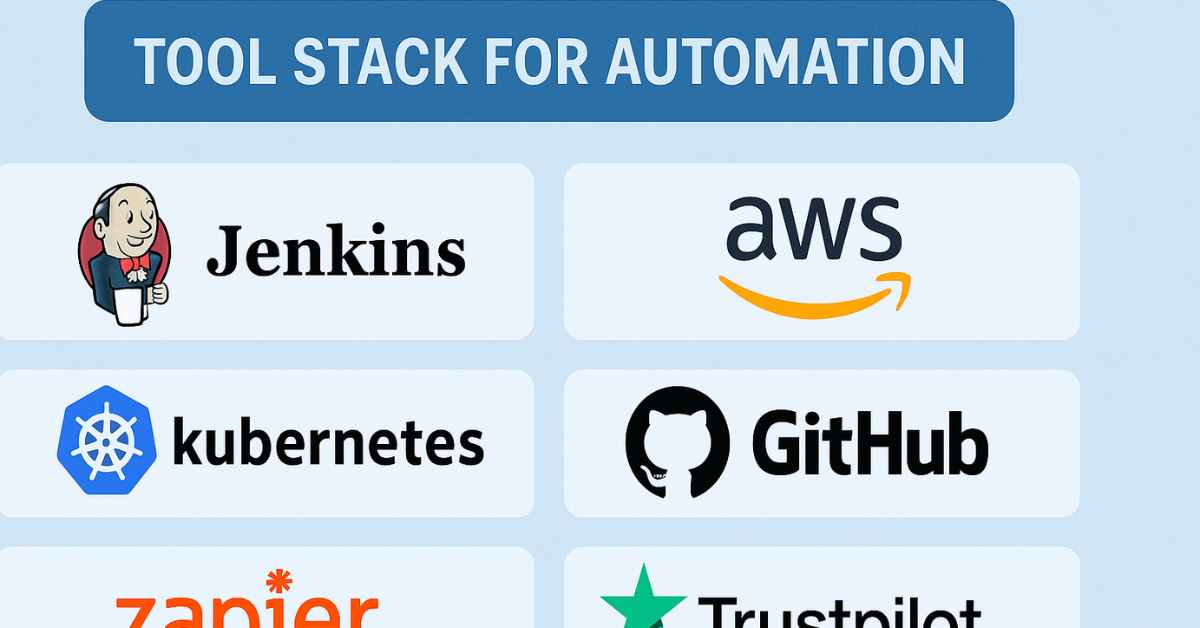
Explore how to build a cohesive tool stack for automation covering both code deployments and marketing campaigns. From CI/CD pipelines to marketing workflows, get practical tools and strategies.
Target Audience
-
Web development agencies (like yours) that support both dev and marketing services.
-
In-house digital teams wanting to streamline from code release → campaign launch.
-
Small to medium businesses in India who want to automate operations but don’t know where to start.
-
Marketers curious about how dev/ops workflows intersect with marketing workflows.
Explain why automation matters across the stack — not just code, but also marketing. Highlight pain points: manual deployments, silos between dev & marketing, repetitive tasks, slow time-to-market.
Introduce the focus keyword: “tool stack for automation”.
Why you need a unified tool stack for automation
-
Silos slow you down (dev stack vs martech stack)
-
Efficiency + reliability: from code commit to campaign launch
-
Scale without proportionally increasing head-count or errors
Anatomy of the automation tool stack
Break down the stack into layers/segments, with examples:
-
Dev/Release Automation (CI/CD, Infrastructure as Code)
-
Tools/systems for code→build→deploy pipelines.
-
-
Workflow & Orchestration (bridging dev & marketing)
-
Tools for event-triggered workflows, cross-system triggers.
-
-
Marketing Automation (campaigns, lead nurture, personalization)
-
Tools for email automation, social scheduling, campaign orchestration.
-
-
Analytics & Feedback Loop
-
Tools to capture metrics from both dev performance (deploy frequency, error rate) and marketing results (conversions, engagement) and feed back into optimisation.
-
Key criteria for choosing your tools
-
Integration: How well tools talk to each other (APIs, webhooks)
-
Automation-friendliness: Supports triggers, workflows, minimal manual intervention
-
Scalability & flexibility: Works as you grow
-
Cost & ROI: Especially for SMBs / Indian market context
-
Localisation / Regional relevance: Indian market, regional teams, mobile first
Sample Tools & Technologies (with Indian/SMB context)
Provide a list of recommended tools for each layer, with pros/cons and use-case.
-
Dev/Release: e.g., CI/CD platforms (mention how this ties into automation of deployments).
-
Workflow/Orchestration: e.g., Zapier, Workato, or event-driven automation platforms.
-
Marketing Automation: e.g., email & campaign platforms (reference list of marketing automation tools).
-
Data & Analytics: tool stacks for martech analytics and data capture.
Also talk about bridging dev & marketing: for example when a new version launches, trigger marketing campaign, update release notes, social posts etc.
Implementation Steps: From Planning to Launch
-
Audit your current stack (dev tools + marketing tools)
-
Map your workflows: Code → Build → Deploy → Release → Marketing Campaign → Analytics
-
Define trigger points & hand-offs (e.g., when deploy completes → trigger marketing workflow)
-
Choose integrations / middleware (APIs, webhooks, connectors)
-
Roll out in phases (start small: e.g., automate one simple workflow)
-
Monitor metrics & iterate (deploy frequency, time to launch, campaign ROI)
Challenges & How to Overcome Them
-
Tool overload / duplication (too many tools) → prioritise best fit.
-
Resistance from teams (dev vs marketing) → encourage shared goals, value of automation.
-
Integration complexity → use middleware/platforms or choose tools with built-in connectors.
-
Cost, training, localization for India → start lean, pick tools with local pricing/support.
-
Data silos & privacy (especially Indian context) → ensure your stack supports first-party data collection, compliant workflows
Summarise the importance of bridging dev & marketing via an automation-tool stack. Encourage readers to start small, pick the right tools for their size and growth stage, and build the workflows that align with business objectives. Emphasise that automation isn’t just for large enterprises — Indian SMBs/local agencies too can adopt with the right strategy.
FAQs
-
Q1: Can small agencies start with free/low-cost tools for automation?
-
Yes – many SaaS tools have freemium/low-cost plans; focus on strategic workflows first.
-
-
Q2: How many tools are “too many” in a stack?
-
If you can’t count your tools easily or see redundancies, you might have too many; aim for lean and integrated.
-
-
Q3: What’s the first workflow I should automate?
-
A good start: automate release announcement + social post + email when code deploys.
-
-
Q4: How does this apply to Indian / regional businesses?
-
Emphasise mobile-first, regional languages, low budget starts, local support & tools with good integrations in Indian context.
-
UseFull Links
- Social Media Analytics Strategy: From Data to Decisions for Your Brand
- Marketing Automation Tools 2025 | Top Platforms for Smarter Campaigns
- Generative Engine Optimization (GEO): How Agencies Must Adapt
Why This Topic Is Relevant Now
-
Automation is increasingly expected across both dev and marketing — speed, efficiency, scalability.
-
With budgets tight (especially for SMBs & agencies), you need to do more with less and automation emerges as a key lever.
-
The tech stack (both dev & martech) is vast and fragmented; a well-thought tool stack helps avoid chaos and redundancy.
-
Indian market context: Many businesses are still largely manual; introducing tool stacks gives them a competitive edge.
-
Bridges skill gaps: Agencies often have dev team and marketing team; aligning them via automated workflows amplifies value.