
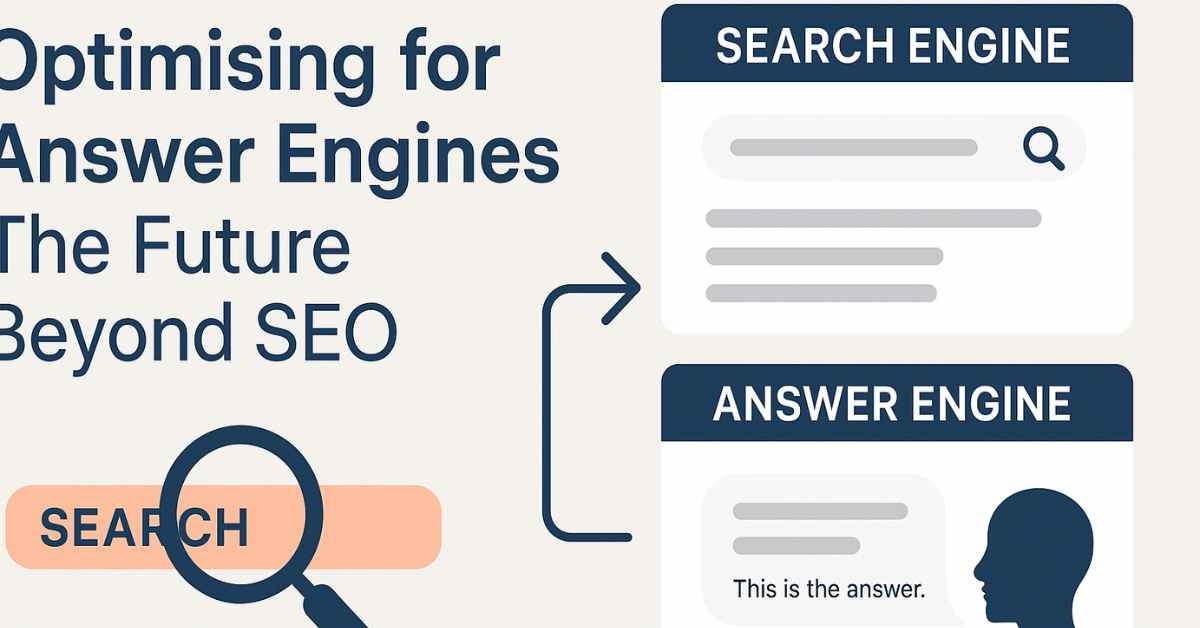
Discover how optimising for answer engines is transforming digital marketing. Learn the strategies and tactics to thrive beyond traditional SEO in 2025.
Introduction
In the evolving digital landscape, simply ranking in the top 10 of Google (or any traditional search engine) is no longer enough. Users expect direct, concise answers — not just a list of links. Enter the era of Answer Engines — systems designed to deliver immediate responses to user queries. Optimising for these systems — also known as Answer Engine Optimisation (AEO) — is becoming the latest frontier for digital marketers and agencies.
In this blog, we’ll explore what optimising for answer engines means, why it matters, how it differs from traditional SEO, and how you can implement an AEO-first strategy for your clients and business.
Quick Facts
-
Answer engines use artificial intelligence and natural-language processing to understand intent and deliver a precise answer instead of a list of web pages.These systems are increasingly creating zero-click outcomes, meaning users get their answer without visiting a website.
-
Optimising for answer engines involves structured data, conversational content, and authoritative signals—much more than keyword density and backlinks alone.
What Are Answer Engines — and Why They Matter
Defining Answer Engines
Answer engines are search-systems built to interpret a user query, retrieve relevant information, and synthesise an answer rather than simply returning a ranked list of pages.
Examples include generative AI chatbots (like ChatGPT or Google Gemini), voice assistants (Siri, Alexa) and search interfaces that directly surface an answer (e.g., featured snippets).
Why the Shift from Traditional SEO?
Historically, ranking in search results meant driving clicks to a website. Today, however:
-
Answer engines can deliver the answer inside the platform, reducing the need for a click.
-
The criteria for being chosen as the ‘answer’ differ: it’s about clarity, structure, authority, and answering intent — not just keyword position.
-
For agencies and businesses, this means visibility and brand presence may depend less on ranking and more on being cited or referenced by these engines.
The Business Implication for 2025
For a digital-solutions agency like yours, this shift is vital:
-
If your clients’ content is not structured for answer engines, you risk missing out on visibility even if you rank well.
-
Traffic patterns may change: fewer clicks but more brand mentions and visibility inside AI tools.
-
The competitive edge will go to those who adapt to AEO strategies early.
Key Differences — SEO vs AEO (Answer Engine Optimisation)
Focus & Metrics
| Factor | Traditional SEO | AEO (Answer Engine Optimisation) |
|---|---|---|
| Goal | Rank pages in search results | Be the source of the answer inside the engine |
| Output | List of links to click | Direct answer, summary, or snippet |
| User behavior | Click through, explore websites | Immediate answer, possible no click (zero-click) |
| Optimisation | Keywords, backlinks, page authority | Intent understanding, structured data, conversational tone |
| Success metrics | Organic traffic, keyword rankings | Answer citations, brand mentions, snippets, voice results |
Several sources explain this shift clearly.
Content Format & Structure
-
Traditional SEO content: Longer articles, keyword-rich, many internal links.
-
AEO-ready content: Concise answers, clear headings (often question-based), structured markup like FAQ schema, tables/lists for quick parsing.
-
Conversational tone matters more, particularly for voice and chat applications.
Authority Signals & Source Credibility
In the AEO world:
-
Being cited by an answer engine matters more than simply ranking well.
-
Structured data, schema markup and consistency become critical signals.
-
Content freshness, clarity and accuracy are also higher priority.
Strategies for Optimising for Answer Engines
Here are actionable steps your agency can deploy for clients, or for your own digital content.
1. Map User Intent and Identify Query Types
-
Use question-based research: “How do I…?”, “What is…?”, “Why does…?”
-
Structure content around direct answers to those questions—keep the answer near the top of the section.
-
Think about voice queries as well: “Hey Siri, what’s the best low-code platform for web apps?”
2. Use Structured Data & Schema Markup
-
Apply
FAQPage,HowTo,QAPage, and other relevant schema types so answer engines can parse your content easily. Provide structured data for entities (people, organizations, products) to strengthen content credibility.
3. Create Clear, Concise Answer Blocks
-
Use headings like “What is …?”, “How to …?” to match conversational queries.
-
Keep answers short (50-100 words) in the first paragraph of the section, followed by elaboration.
-
Use bullet lists and tables for easier parsing by AI systems.
4. Build Topical Authority
-
Cover related questions comprehensively, linking between them to show depth.
-
Use your domain as a trusted source: publish regularly, maintain freshness, cite third-party sources.
-
Garner mentions and citations from authoritative websites—these help answer-engines trust your content.
5. Monitor and Adapt for Voice & AI Interfaces
-
Test your content via smart speakers (Alexa, Google Home) or AI chatbots to see how your answer reads.
-
Include conversational phrasing and anticipate follow-up questions: for example, after “What is AEO?”, a user might ask “Is AEO better than SEO?”.
-
Consider the mobile/voice UX: content should load fast, be readable and structured for small-screen or audio output.
6. Internal Links & Content Architecture
-
Use internal linking to map related questions and answers. This helps the engine traverse your site as a knowledge graph of sorts.
-
Maintain consistency in naming, vocabulary and entity references across the site (reduces ambiguity for AI).
What This Means for Agencies & Clients in India
Service Bundle Evolution
If you’re an agency like Epixs Media, consider adding “AEO readiness” audits and “answer-engine optimisation” as a distinct service. Package your services as:
-
Audit of existing content for AEO readiness
-
Schema implementation + conversational rewrite of key pages
-
Monitoring of zero-click metrics and AI-citations
-
Client education: Why being picked by AI matters even if click-through drops
Pricing & Positioning
-
Shift from “rank on Google” to “be the answer on AI and voice platforms”.
-
Highlight benefits: brand presence inside voice assistants and chatbots, not just on the website.
-
Provide value-based pricing: e.g., “We help your business appear in AI-answers for 10 high-intent questions in 90 days”.
Indian Market Considerations
-
Local language queries: voice search in Hindi, Telugu, Tamil etc will grow — optimise for multilingual, conversational content.
-
Mobile-first and low bandwidth regions: content must load fast and work well in voice-interface contexts.
-
Emerging platforms: Indian users may adopt AI chat apps and local voice assistants — early positioning helps.
Future Outlook & What to Watch
-
The percentage of informational queries answered inside AI/answer-engine interfaces will continue increasing — early estimates show a noteworthy shift.
-
Traditional SEO traffic may decline for certain query types; brands need to diversify visibility beyond just “top-10 search”.
-
New metrics will emerge: how many times your brand was cited in an answer engine response, not just how many clicks you got.
-
Tools and platforms will start offering “answer-engine optimisation” features — staying ahead gives you a competitive advantage.
-
As Indian digital infrastructure improves, answer-engine and voice interfaces will become mainstream even in Tier-2/3 cities — localisation, conversational content and speed will be key.
Conclusion
Optimising for answer engines is not about abandoning traditional SEO — it’s about evolving your strategy to remain visible in a world where answers matter more than links. By embracing Answer Engine Optimisation (AEO), your agency can position clients to be the answer, not just another result.
Focus on user intent, structured content, authority and visibility inside AI-driven interfaces. The future beyond SEO is about being selected, cited, and trusted — and that journey starts now.
FAQs
Q1: Is optimising for answer engines the same as SEO?
A1: Not exactly. SEO focuses on ranking pages in a list of links; AEO focuses on delivering or being selected as the answer itself inside an engine.
Q2: Does this mean clicks are no longer important?
A2: Clicks still matter, especially for conversions. But AEO emphasises being present in the moment a user asks the question — even if no click happens.
Q3: Can small businesses benefit from AEO?
A3: Absolutely. Especially if you target specific conversational queries in your niche, localised content and voice search, you have a chance to be cited and gain visibility beyond traditional rankings.
Useful Links
Author: Arun Reddy – Digital Solutions Specialist
Bio: Arun Reddy is a web solutions and digital growth consultant at Epixs Media Blog. He helps businesses in India and abroad build high-performance websites, run effective campaigns and stay ahead in marketing technology.
Publish Date: 2025-11-03
Last Updated: 2025-11-03