
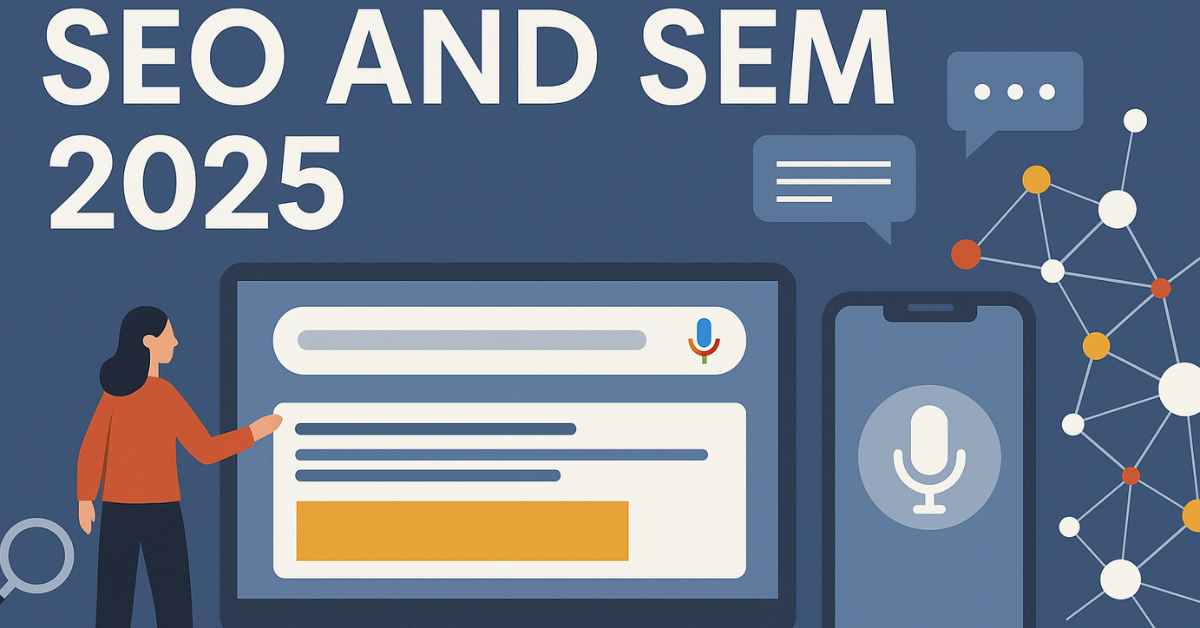
The worlds of search engine optimisation (SEO) and search engine marketing (SEM) are undergoing major transformation in 2025. With growing use of voice search, generative-AI driven answer engines, and shifting advertising models, businesses and agencies (including here in India) need to adapt fast. This article explains the evolution of SEO and SEM 2025 — highlighting what’s changing, what to focus on, and actionable steps you can apply at your agency or for your clients (for example at Epixs.in).
Quick Facts
-
Voice search queries are now significantly more conversational and long-tail, requiring a change in keyword strategy.
-
Paid search costs (CPC/CPM) are rising, and automation + AI is dominating SEM.
-
A new paradigm — “Answer Engine Optimisation” or “Generative Engine Optimisation” — is emerging as search becomes more AI-driven.
1. Voice Search & Conversational Queries (SEO)
Why voice search matters in 2025
Voice search (via smart-speakers, mobile assistants, IoT devices) is changing how users ask queries — more natural language, longer queries, often local intent.
For Indian context: Many users will speak queries in local languages or mix of English plus regional. Optimising for voice means adapting to that behaviour.
How to optimise for voice search
-
Target long-tail conversational queries and question phrases (who/what/where/how).
-
Focus on local SEO (near me, voice + location) since voice queries often have local intent.
-
Ensure mobile-friendly, fast-loading sites with clean UX — voice search users expect instant answers.
-
Use structured data (schema markup) and FAQ/How-To sections so that search engines (and voice assistants) can pull clear answers.
Tip for Epixs clients: When you build websites for local businesses (Tirupati / Andhra Pradesh), include a “Voice-FAQ” section phrased as questions people might ask verbally. This will future-proof for voice search.
2. The Shift from Traditional SEO to Agentic / Generative Search
What is “agentic web” / generative search optimisation?
Search is evolving: instead of lists of links, users increasingly get summaries, answers, or chat-based results generated by AI. Terms like Answer Engine Optimization (AEO) or Generative Engine Optimization (GEO) describe optimising content to appear in these AI‐driven responses rather than only classic SERPs.
This means you need to rethink content strategy: answer clusters, authoritative content, structured data, direct value.
How your SEO strategy changes
-
Focus on intent over keywords. Provide clear, concise answers that an AI or voice assistant could read.
-
Build content with topical breadth and depth (cover question-clusters around your core topic).
-
Use schema markup, structured data, entity relationships because AI systems rely on that to pull and contextualise information.
-
Monitor not just organic ranking but visibility in generative results (how often your brand/content appears in AI answers).
Tip: For the Epixs blog or client sites, include data, authoritative citations, and use schema (FAQ, HowTo, LocalBusiness) so your content is “readable” by AI/voice engines.
3. SEM in 2025: Paid Search & Advertising Trends
Key SEM shifts
-
Paid search costs are rising — CPCs and CPMs up significantly.
-
Automation, AI, and machine learning dominate campaign management (bidding, copy creation, asset generation).
-
Data privacy, first-party data, and changes to targeting (less reliance on third-party cookies) matter.
-
New ad formats and channels: voice / visual search ads, more interactive formats.
SEM strategy for 2025
-
Use AI-enabled tools and smart bidding but keep human strategy in loop to guide budgets and guardrails.
-
Harness first-party data (customer lists, CRM integration) for targeting and measurement.
-
Optimise landing pages and conversion funnels: faster load times, matching intent, mobile-first.
-
Diversify ad channels beyond Google Search (consider visual, voice, social-search).
-
Monitor ROI closely — with rising costs, you must optimise for conversions not just clicks.
Tip: For Indian agencies or clients, emphasise smart-budget allocation, test newer formats (voice-search ads, visual search), and report on metrics tied to conversions (not just impressions).
4. Content, UX & Technical Factors That Tie SEO + SEM Together
Performance & Technical SEO still matter
Even as search evolves, fundamentals apply: site speed, mobile-first design, structured data, good UX. These impact both organic and paid results.
Content must match user intent & journey
-
For SEO: content should answer real user questions, structured for voice/generative.
-
For SEM: landing pages must reflect ad intent, easy to convert, clear value.
-
Use interactive formats (video, FAQ, micro-interactions) to engage users who come via paid or organic paths.
Unified measurement across SEO + SEM
With overlapping ecosystems (voice, AI, search + ads), track user paths across channels. Attribution models must evolve (first-party data, server-side tracking).
5. Action Plan for Indian Businesses & Agencies
-
Audit existing sites for voice query readiness: look at FAQ pages, long-tail question keywords, structured data.
-
Update ad campaigns for 2025: review bidding strategy, shift to Performance-Max / AI-driven ads, align with first-party data.
-
Build content around questions users ask verbally, regionally relevant (for Indian languages + English mix).
-
Integrate SEO + paid teams so content, landing pages and ads are aligned.
-
Set up analytics/reporting to include new KPIs: voice search traffic, generative visibility, conversion cost.
-
Stay updated: search ecosystem is changing fast — attend webinars, read authority sources (e.g., Search Engine Land).
In 2025, mastering SEO and SEM means more than just traditional ranking or ad-clicks. It requires adapting to voice search, conversational queries, generative-AI driven answers, and new paid media dynamics. For agencies like Epixs and businesses in India, the opportunity is clear: build websites and campaigns that are mobile-first, voice-ready, AI-optimised, and data-driven.
Focus on these core pillars:
-
Voice & local search optimisation
-
Content for generative/agentic web
-
AI + automation in paid media
-
Technical foundations + unified measurement
By doing so, you will future-proof your digital marketing strategy and stay ahead in a search landscape that is evolving fast.
FAQs
Q1. Do I still need to do classic keyword research in 2025?
Yes — but your keyword research must include conversational long-tail queries, question forms, and intent-driven phrases. The nature of queries is shifting.
Q2. Will voice search become the only search method?
Not only, but a growing part. Voice queries and AI answers are increasing, especially for mobile and local tasks. You should optimise for both typed and spoken queries.
Q3. How should I allocate budget between SEO and SEM?
There’s no one-size-fits-all. But given rising CPCs and evolving SEO, many businesses will benefit by balancing: invest in quality content + technical SEO for long-term organic, and optimise SEM for immediate results with automation + tracking.
Useful Links
-
Search Engine Land: 4 PPC trends to monitor closely in the second half of 2025
-
SEOmator: The Rise of Voice Search: What It Means for SEO in 2025
-
Internal links: Epixs – Digital Marketing, Epixs – Web Design
Author: Priya Sharma – Senior Web Engineer & Digital Strategy Lead at Epixs.in
Bio: Priya has eight + years of helping Indian SMEs grow through web design, digital marketing and advertising. She writes practical guides in simple Indian English.