
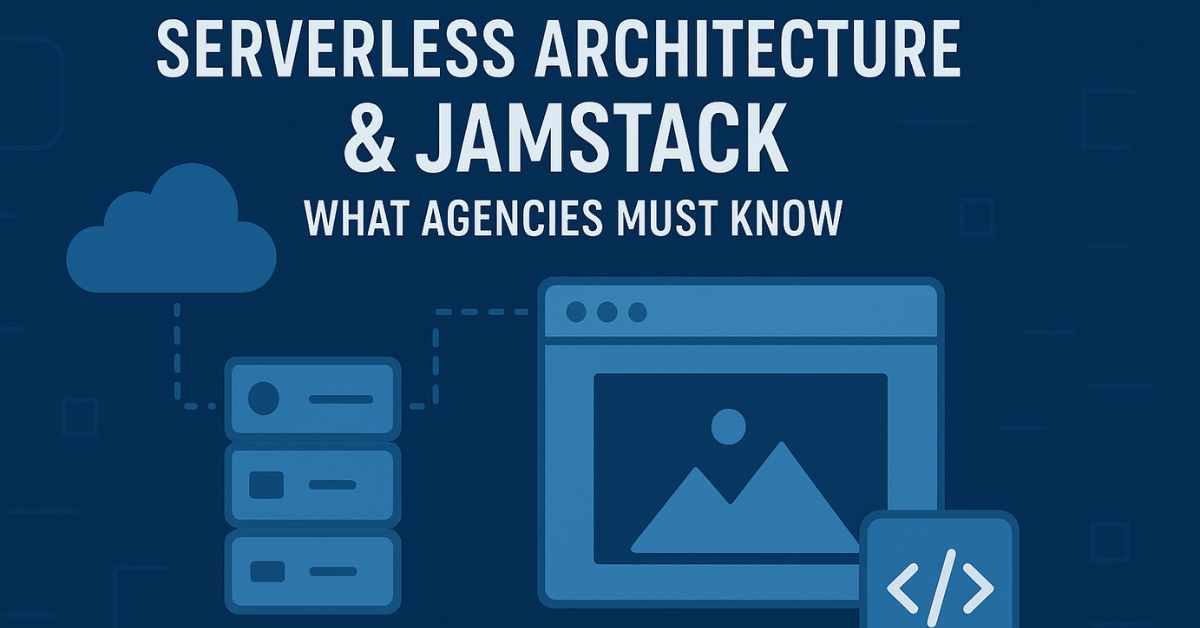
Discover how serverless architecture and the JAMstack approach empower agencies — for faster sites, lower maintenance, and better client outcomes.
As agencies take on more complex web projects, the traditional monolithic CMS + server model is increasingly showing its limits — in speed, scalability, maintenance cost and developer agility. That’s where serverless architecture combined with the JAMstack approach comes into sharp focus. This article unpacks what serverless architecture JAMstack means, why it matters for web-development agencies, how to implement it effectively, and what pitfalls to avoid.
Quick Facts
-
JAMstack stands for JavaScript, APIs, and Markup — a web-architecture pattern where static markup and pre-rendered pages are served from CDNs, and dynamic behavior is handled via APIs or serverless functions.
-
Serverless functions allow backend logic to run without you managing servers — the cloud provider handles scaling, infrastructure and provisioning.
-
Together, serverless + JAMstack deliver faster load times, lower infrastructure/maintenance cost, and improved scalability and security.
-
For agencies serving clients who expect rapid iteration, high-traffic bursts, or marketing-driven rollout, this architecture can be a strong competitive differentiator.
Why It Matters for Agencies
As a web development or digital marketing agency (such as Epixs), you face several pressures: faster time-to-market, tighter budgets, better ROI for clients, and growing expectations around performance, UX and scalability. Serverless + JAMstack address many of these:
-
Speed of delivery: With static markup + pre-rendering + API-driven logic, setup and deployment cycles can be faster compared to traditional server + CMS builds.
-
Maintenance overhead falls: Less infrastructure to manage (no servers to patch, fewer plugins) means ongoing costs and risk drop.
-
Scalability & performance: High-traffic bursts, global audiences and mobile-first users demand scalable architecture; JAMstack + serverless meets it.
-
Better SEO & UX: Faster load times, global CDN delivery and decoupled architecture contribute to improved rankings and user experience.
-
Modern positioning: Using “serverless architecture JAMstack” becomes a selling point when pitching to clients who value modern tech and future-proofing.
Core Concepts: Serverless + JAMstack
What is Serverless Architecture?
Serverless architecture means you write functions (often called “serverless functions”) that run on demand, provided by cloud vendors (like AWS Lambda, Netlify Functions, Vercel Edge Functions). You do not manage the underlying servers. As the official JAMstack glossary explains:
“‘Serverless’ or ‘serverless functions’ are a means of providing a run-time environment for code without the need for knowledge of, or control over, the underlying environment.”
Key traits: event-driven, stateless, pay-for-what-you-use, minimal ops overhead.
What is JAMstack?
JAMstack is a front-end architecture where pages are built ahead of time (pre-rendered or statically generated), served via a CDN, and dynamic behaviour happens via APIs or serverless functions.
Elements of JAMstack:
-
JavaScript running in the browser for UI logic
-
APIs for data, authentication, server logic
-
Markup (static HTML) generated ahead of time and served via CDN
Key benefits: high performance, scalability, security, ease of asset caching.
How They Fit Together
For agencies, the synergy is strong: use JAMstack for your front-end pre-rendered site and deploy it globally via CDN; use serverless functions to handle whatever dynamic logic remains (form submissions, user auth, custom APIs). This architecture minimises server maintenance, reduces response latency for users globally (especially via edge functions), and allows the dev team to focus on features, not ops.
Implementation Roadmap for Agencies
Here’s a structured roadmap you can follow (and adapt) for your agency projects.
Step 1 – Audit & Planning
-
Identify the client website’s current architecture: CMS, hosting, traffic patterns, performance bottlenecks.
-
Determine what parts are truly dynamic (user login, custom APIs, real-time data) and what parts are static content.
-
Choose tech stack: Static Site Generator (SSG) such as Next.js, Gatsby, Nuxt.js; Headless CMS (e.g., Sanity, Contentful); Serverless provider (Netlify, Vercel, AWS etc).
-
Map cost model & client needs: Determine if serverless cost vs traditional hosting is justified (especially if traffic predictable).
-
Set performance/UX/SEO goals.
Step 2 – Build Front-End with JAMstack
-
Use SSG to pre-render pages; integrate Headless CMS so content editors can update without full redeploys.
-
Deploy static assets to CDN for global speed and reliability.
-
Use best practices: image optimisation, lazy-loading, accessible markup, SEO meta-tags.
-
Connect APIs for dynamic parts (e.g., blog comments, user forms).
Step 3 – Add Serverless Functions for Backend Logic
-
Create functions for modular tasks: form submissions, authentication, payment processing, search indexing.
-
Choose event-driven triggers: HTTP endpoints, cron jobs, database changes.
-
Ensure good function design: small, single-purpose functions, stateless design, minimal cold-start latency.
-
Set up CI/CD: functions deploy automatically, tests included.
Step 4 – Hosting & Deployment
-
Use a platform supporting JAMstack + serverless (Netlify, Vercel, AWS Amplify).
-
Set up caching/purge strategies for static content updates.
-
Use edge functions if available for very low-latency geographic delivery.
-
Establish proper environment variables, secrets management, domain/CDN settings.
Step 5 – Monitoring, Cost & Maintenance
-
Monitor function invocation counts, execution time, errors; use tools like CloudWatch, Datadog.
-
Track hosting and edge usage to avoid runaway bills: serverless can scale automatically but cost may spike.
-
Ensure access control, least privilege, API security.
-
Plan for content updates: if using incremental static regeneration (ISR) or partial rebuilds, ensure your tooling supports it.
Step 6 – Client Handoff & Agency Workflow
-
Document workflow for content editors (how to update Headless CMS).
-
Provide training/guidelines for future updates.
-
Offer maintenance-plan: frequently update dependencies, audit serverless billing, monitor performance over time.
-
Highlight benefits to clients: faster site, less torubleshooting, better UX, future-proof architecture.
Challenges & Mitigation
No architecture is perfect. Agencies must be aware of issues and prepared.
-
Cold-starts & latency in functions: While serverless functions are efficient, the first invocation after idle may incur delay. Mitigation: keep functions warm or use platforms with pre-provisioned concurrency.
-
Vendor lock-in: Using specific serverless/CDN provider APIs may make migration hard. Mitigation: choose frameworks that abstract providers, write portable code.
-
Complexity for dynamic needs: For highly custom backend logic, micro-services or monoliths may still make sense. Some developers caution against “serverless hype.
-
Billing surprises: Because serverless pays per invocation, unexpected traffic or mis-configured triggers can cause cost spikes. Key: monitor and set budget alarms.
-
Build times: For very large static sites, SSG build times may grow. Use incremental builds or hybrid SSG/SSR frameworks.
For agencies, embracing serverless architecture JAMstack can unlock major advantages: faster builds, better scalability, lower maintenance overhead, and a modern value proposition for clients. The transition demands careful planning, skill in modern frameworks, and vigilant cost/ops monitoring — but the payoff is strong.
Next step for your agency: Audit your upcoming client sites and ask: “Could we rebuild this as a JAMstack + serverless deployment?” Select one pilot project, align your team on the stack (Headless CMS + SSG + serverless platform), set performance & cost KPIs, build the workflow, and iterate. Over time, standardise your architecture template so you can deliver high-quality modern sites at scale.
FAQs
Q1: Is serverless architecture JAMstack only for small sites or marketing microsites?
A1: Not at all. While the pattern started with simpler static sites, by 2025 it increasingly applies to enterprise-scale projects with dynamic features, thanks to edge functions, hybrid frameworks and API-first strategies.
Q2: Will my agency lose flexibility if we move to static sites and serverless?
A2: Actually the opposite — building decoupled front-end + APIs gives more agility. Front-end teams can iterate without worrying about backend changes; backend logic is modular. However, you do need to plan your modular architecture properly.
Q3: How does this affect SEO and content editing for clients?
A3: Positive. Pre-rendered pages are fast, globally distributed, and easy for search engines to crawl. Using a Headless CMS gives clients editing freedom. Just make sure you include proper metadata, canonical tags, link structure and internal links (for example linking to your other service pages on Epixs.in).
Useful Links
- Epixs – Web Development Services
- Epixs – Digital Marketing & Social Media Services
- Brand Growth Through Performance Marketing: Indian Start-ups Case Studies
- Tool Stack for Automation: Code Deployments to Marketing Campaigns
Author Pack
Author: Rohit Mehta (Lead Technical Strategist, Epixs)
Bio: Rohit specialises in cutting-edge web architectures, helping Indian and global brands migrate to modern, scalable, low-maintenance platforms.
Profile Image Alt Text: Rohit Mehta Epixs Lead Technical Strategist
Publish Date: 2025-10-29
Last Updated Date: 2025-10-29